Writing exhibition captions requires a delicate balance between providing factual information and telling a compelling story that resonates with every visitor. These small blocks of text serve as the essential bridge between the artist’s vision and the audience’s personal experience within the gallery space. By focusing on clear language and meaningful context, you can transform a simple display into an immersive journey that encourages deeper exploration and stays in the viewer’s mind long after they leave.
Modern exhibition captions are no longer just dry lists of dates and materials but are powerful tools for museum interpretation and accessibility. When you craft your gallery labels with the visitor in mind, you ensure that complex art concepts become approachable and inclusive for diverse audiences. Using an engaging narrative style helps to highlight the historical significance and emotional depth of the work, making the information feel relevant to the current cultural moment.
To create truly effective exhibition captions, you should focus on punchy sentences that deliver high value without overwhelming the reader with technical jargon. Including curated details about the creative process or the cultural background of the exhibit helps build a stronger connection between the art and the public. A well-written label acts as a silent guide, enhancing the visual experience while providing the necessary clarity to make every display both memorable and educational.
Professional Standards for Exhibition Captions
Expert curators understand that high-quality exhibition captions are the foundation of a successful visitor experience in any gallery or heritage site. By integrating precise historical context with accessible language, these descriptions bridge the gap between complex artistic concepts and public understanding. This authoritative approach ensures that every interpretive label provides credible, well-researched insights that enhance the educational value of the entire collection.
Creating effective exhibition captions involves a deep knowledge of storytelling and a commitment to inclusivity for diverse audiences. These narrative descriptions serve as vital signage that guides the viewer through the creative process while highlighting the cultural significance of each artifact. By focusing on clarity and factual accuracy, curators can establish trust and provide a meaningful framework that makes contemporary art and historical displays more relatable.
Strategic exhibition captions also prioritize the modern digital landscape by utilizing clear terminology that reflects current museum standards and visitor expectations. Including specific details about materials, techniques, and provenance adds layers of depth that satisfy curious minds and professional researchers alike. This comprehensive method of writing labels ensures that your exhibit remains an engaging, high-authority resource that stands out for its insight and professional quality.
How to Write Professional Exhibition Captions
Writing professional exhibition captions requires a strategic blend of factual data and compelling storytelling. Start by organizing the “tombstone” information, which includes the artist’s name, the title of the work in italics, the date, and the materials used. This clear structure allows visitors to identify the piece immediately before diving into the deeper narrative provided in the interpretive text below.
Crafting a Compelling Narrative Hook
A successful caption must grab the viewer’s attention within the first few seconds of reading. Instead of starting with dry historical dates, lead with a powerful “hook” that connects the artwork to a universal human experience or a significant cultural event. By answering the “so what?” factor early on, you ensure that visitors remain engaged and curious about the rest of the display’s history.
Maintaining Accessibility and Inclusive Language
Professional gallery labels must be inclusive and easy to understand for a diverse audience. Avoid using overly academic jargon that might alienate casual visitors; instead, aim for a clear and conversational tone that explains complex concepts simply. This approach ensures that your content is accessible to students, tourists, and art experts alike, making the exhibition a welcoming space for everyone.
Optimizing Word Count for Visitor Engagement
To prevent “museum fatigue,” it is essential to keep your exhibition captions concise and focused. The ideal length for an interpretive label is between 50 and 150 words, broken into short, punchy paragraphs. By limiting the text to one or two key ideas per label, you provide high value without overwhelming the reader, ensuring they stay energized throughout the entire gallery tour.
Technical Formatting for Maximum Readability
The physical presentation of your captions is just as important as the writing itself. Use high-contrast colors, such as black text on a white or cream background, and ensure the font size is at least 18pt for body text to assist with readability. Proper alignment and a clean, sans-serif font help the eye track the information easily, creating a seamless visual experience that complements the artwork.
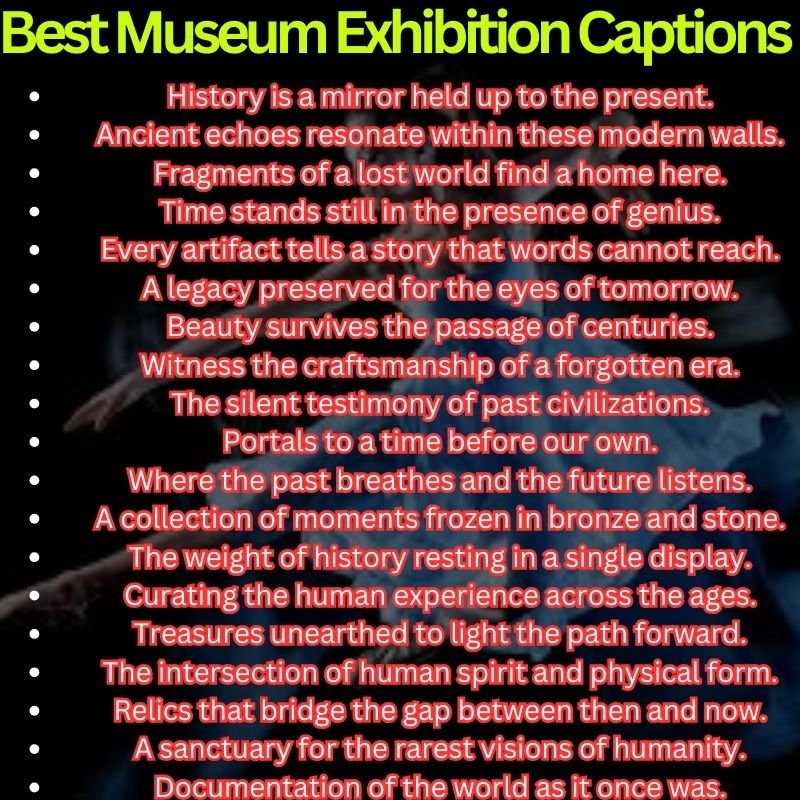
Best Museum Exhibition Captions and Examples
- History is a mirror held up to the present.
- Ancient echoes resonate within these modern walls.
- Fragments of a lost world find a home here.
- Time stands still in the presence of genius.
- Every artifact tells a story that words cannot reach.
- A legacy preserved for the eyes of tomorrow.
- Beauty survives the passage of centuries.
- Witness the craftsmanship of a forgotten era.
- The silent testimony of past civilizations.
- Portals to a time before our own.
- Where the past breathes and the future listens.
- A collection of moments frozen in bronze and stone.
- The weight of history resting in a single display.
- Curating the human experience across the ages.
- Treasures unearthed to light the path forward.
- The intersection of human spirit and physical form.
- Relics that bridge the gap between then and now.
- A sanctuary for the rarest visions of humanity.
- Documentation of the world as it once was.
- The enduring power of cultural identity.
- Tracing the footsteps of those who came before.
- An archive of the soul expressed through objects.
- Preserving the delicate threads of our shared heritage.
- The artistry of survival and the grace of creation.
- Foundations of the modern world on display.
- A visual dialogue between ancestors and descendants.
- The evolution of thought captured in material.
- Whispers of the past amplified for the modern ear.
- A masterclass in the persistence of memory.
- Icons of change that redefined their generation.
- The texture of time felt through curated remains.
- Stories etched into the fabric of reality.
- An exploration of the heights of human ingenuity.
- Celebrating the diversity of the global narrative.
- Significant markers of the human journey.
- A testament to what remains when time moves on.
- The physical manifestation of historical turning points.
- Reframing the way we see the world’s origins.
- A journey through the halls of collective memory.
- Discovering the extraordinary in the ancient.
- Symbols of power and artifacts of the everyday.
- The chronicle of human ambition in physical form.
- Guardians of the stories that define us.
- A curated walk through the landscape of time.
- The pulse of history beating within the gallery.
- Finding our place in the long line of creators.
- Remnants of brilliance salvaged from the dust.
- The architecture of human progress revealed.
- An intimate look at the giants of history.
- Where every object is a chapter in a larger book.
- Cultivating a deeper understanding of our roots.
- The profound silence of historical truth.
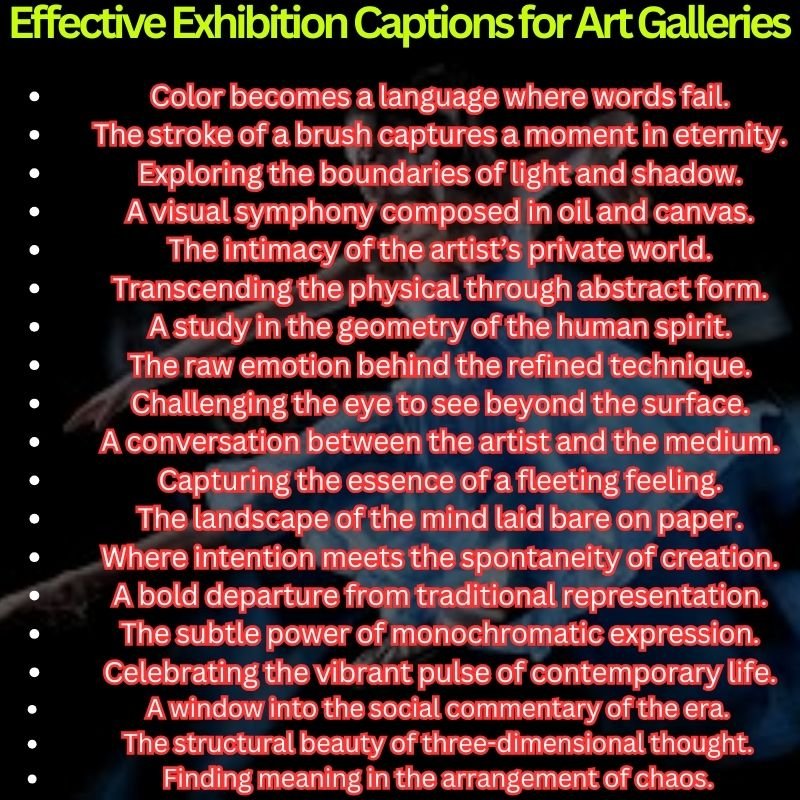
Effective Exhibition Captions for Art Galleries
- Color becomes a language where words fail.
- The stroke of a brush captures a moment in eternity.
- Exploring the boundaries of light and shadow.
- A visual symphony composed in oil and canvas.
- The intimacy of the artist’s private world.
- Transcending the physical through abstract form.
- A study in the geometry of the human spirit.
- The raw emotion behind the refined technique.
- Challenging the eye to see beyond the surface.
- A conversation between the artist and the medium.
- Capturing the essence of a fleeting feeling.
- The landscape of the mind laid bare on paper.
- Where intention meets the spontaneity of creation.
- A bold departure from traditional representation.
- The subtle power of monochromatic expression.
- Celebrating the vibrant pulse of contemporary life.
- An exploration of texture as a narrative tool.
- The harmony found in visual dissonance.
- Translating the intangible into a tangible form.
- A window into the social commentary of the era.
- The structural beauty of three-dimensional thought.
- Finding meaning in the arrangement of chaos.
- A tribute to the masters of perspective.
- The evolution of a signature style over decades.
- Visual poetry written in the language of form.
- The intersection of personal identity and public art.
- Reimagining the world through a creative lens.
- The delicate balance of composition and color.
- An immersive dive into the surreal and the strange.
- The quiet dignity of a portrait well painted.
- Capturing the rhythm of movement on a static plane.
- A celebration of the hand-made in a digital age.
- The tension between reality and artistic vision.
- Decoding the symbolism hidden within the frame.
- A journey through the palettes of the past.
- The visceral impact of large-scale installation.
- Celebrating the minimalist approach to complex ideas.
- The play of light on a sculptured surface.
- An invitation to contemplate the beauty of the mundane.
- The legacy of an artistic revolution captured here.
- Art as a catalyst for social and internal change.
- The whisper of a sketch before the roar of the painting.
- Finding the extraordinary in the artist’s gaze.
- The rhythmic repetition of shape and line.
- A curated look at the pioneers of modernism.
- The bold use of space to evoke a specific mood.
- Exploring the relationship between art and environment.
- The enduring charm of classical aesthetics.
- A reflection on the nature of beauty and truth.
- The artist’s response to the world around them.
- Bridging the gap between the viewer and the vision.
Creative Exhibition Captions for Modern Displays
- The future is being written in this very room.
- Breaking the glass ceiling of traditional media.
- A bold experiment in the limits of perception.
- Where technology and human emotion collide.
- The pulse of the digital age in physical form.
- Challenging the status quo with every installation.
- An immersive world built from light and sound.
- Reimagining the everyday through a radical lens.
- The art of the unexpected and the avant-garde.
- A neon dream captured in a gallery space.
- Exploring the intersection of biology and art.
- The raw energy of the street brought indoors.
- Deconstructing the concept of the traditional gallery.
- A playground for the senses and the intellect.
- Modern visions that defy simple categorization.
- The beauty of the glitch in a perfected world.
- Sculpting with the air and the space between.
- A reflection of our fast-paced global culture.
- Using the past to fuel a futuristic vision.
- The minimalist aesthetic of the maximum impact.
- An interactive journey through modern thought.
- Capturing the chaos of the twenty-first century.
- The elegance of industrial materials repurposed.
- A study in the fluidity of contemporary identity.
- Art that responds to the presence of the viewer.
- Challenging the viewer to become a participant.
- The vibrant colors of a world in transition.
- A celebration of the modular and the geometric.
- Reclaiming the narrative through modern media.
- The quiet power of the conceptual movement.
- An exploration of the virtual made tangible.
- The social network expressed through physical art.
- A daring look at the mechanics of the mind.
- Transforming the mundane into the monumental.
- The poetry of the machine and the algorithm.
- A visual manifestation of the data that defines us.
- Breaking the rules to find a new truth.
- The intersection of fashion, art, and architecture.
- A modern take on the ancient art of storytelling.
- The evolution of the image in a screen-based world.
- Pushing the boundaries of what art can be.
- A symphony of motion in a static environment.
- The stark beauty of the urban landscape.
- An invitation to see the world differently.
- The art of the moment, for the moment.
- Exploring the fragility of our modern ecosystem.
- A bold statement on the power of the individual.
- The fusion of organic forms and synthetic materials.
- A journey to the edge of the creative frontier.
- Where the only limit is the imagination.
- Modernity is a work in progress.
Interpretive Exhibition Captions for Better Engagement
- What do you see when you look at this?
- Consider the hands that shaped this object.
- Imagine the world as it looked through these eyes.
- How does this work change your perspective?
- The story begins where the object ends.
- A prompt to explore your own inner landscape.
- Connecting the artist’s struggle to our own.
- Think about the sound this object might make.
- What would this piece say if it could speak?
- Reflect on the emotions this color evokes.
- The artist invites you to fill in the blanks.
- A journey into the “why” behind the “what.”
- How does the scale of this piece make you feel?
- Notice the details that are usually overlooked.
- The hidden history behind a simple facade.
- Why do you think the artist chose this medium?
- Consider the impact of this work on its era.
- An invitation to pause and truly observe.
- What memories does this image trigger for you?
- The dialogue between the creator and the critic.
- Explore the layers of meaning beneath the surface.
- A question posed to the viewer by the artist.
- How does this object represent its culture?
- Think about the journey this piece took to get here.
- The artist’s intent versus the viewer’s experience.
- What does this work tell us about being human?
- An opportunity to see through a different lens.
- The relationship between the part and the whole.
- Consider the environmental factors that shaped this.
- How does the light change the way you see it?
- A challenge to look beyond your first impression.
- The story of the maker is hidden in the marks.
- What does this piece suggest about the future?
- Reflect on the materials and their origins.
- How does this work connect to your own life?
- The silent conversation between the art and you.
- An exploration of the themes that unite us all.
- Why is this object still relevant today?
- Think about the choices the artist didn’t make.
- The power of art to provoke and inspire.
- What is the first word that comes to mind?
- Consider the weight of the history displayed here.
- How does this work challenge your assumptions?
- The artist’s vision is a starting point for yours.
- Discover the personal narrative within the public art.
- What would you add to this if you were the creator?
- The impact of social change on artistic expression.
- Reflect on the concept of beauty in this context.
- An invitation to engage with the unknown.
- The gallery is a space for your own interpretation.
- Engagement is the bridge to understanding.
Writing Accessible Exhibition Captions for Visitors
- Clear language makes history available to everyone.
- Simple sentences carry the weight of big ideas.
- Large print ensures that no one is left behind.
- Direct descriptions aid in visual understanding.
- Avoiding complex terms broadens the visitor base.
- High contrast text makes reading effortless.
- Audio descriptions bring the visual to life.
- Braille labels offer a tactile path to art.
- Keeping text at eye level for all abilities.
- Short paragraphs respect the viewer’s energy.
- Easy-to-read fonts improve the gallery experience.
- Every visitor deserves a clear explanation.
- Removing barriers through thoughtful communication.
- A welcoming tone makes the museum inclusive.
- Providing context for those new to the subject.
- Using plain English to describe complex art.
- Ensuring the lighting is bright enough for reading.
- Placing labels where they are easy to reach.
- Summarizing the main point in the first sentence.
- Using icons to help guide the way.
- Offering multi-sensory ways to engage with text.
- Making sure the vocabulary is accessible to children.
- Creating a flow that is easy to follow physically.
- Using active verbs to keep the reader engaged.
- Providing digital versions for personal devices.
- Ensuring that physical labels are not obstructed.
- Using consistent formatting for easy navigation.
- Explaining any technical terms used in the exhibit.
- Focusing on the most important facts first.
- A commitment to making art a shared experience.
- Breaking down long texts into smaller chunks.
- Using a font size that can be read from a distance.
- Offering translations for the local community.
- Ensuring the caption is as inclusive as the art.
- Creating a welcoming atmosphere through words.
- Using descriptive titles that summarize the work.
- Providing clear directions within the caption.
- Avoiding idioms that might confuse non-native speakers.
- Ensuring the text is clear of any visual clutter.
- Making the museum a place for all minds.
- Using a layout that is predictable and logical.
- Providing enough space between lines for clarity.
- Focusing on the universal themes of the work.
- Ensuring that everyone can participate in the story.
- Using digital aids to enhance the reading experience.
- Keeping the language respectful and considerate.
- Making sure the “takeaway” is clear and simple.
- Providing a glossary for specialized exhibitions.
- Ensuring the caption height is wheelchair accessible.
- Accessibility is the key to true public service.
- Opening the doors of knowledge through clear text.
ALSO READ: 500+ Captions for Art Gallery Perfect for Art Lovers
Digital Exhibition Captions for Virtual Tours
- Click to explore the hidden details of this work.
- A virtual journey through the artist’s studio.
- Zoom in to see the texture of the brushstrokes.
- Navigate the gallery from the comfort of home.
- An interactive deep dive into the historical archive.
- Experience the exhibit in a full 360-degree view.
- Tap on an object to unlock its secret history.
- A curated digital experience for the modern explorer.
- Bringing the museum to your screen, wherever you are.
- Discover the layers of the painting with a single click.
- A virtual walk through the halls of the past.
- Explore the evolution of the gallery in digital form.
- Engaging with art in a whole new dimension.
- The digital twin of our physical collection.
- An immersive storytelling experience online.
- Follow the guided tour through your mobile device.
- Real-time access to the world’s greatest treasures.
- A personalized journey through the exhibition.
- Unlocking the vault of the museum virtually.
- Watch the art come to life with digital animation.
- Listen to the curator’s commentary as you browse.
- A seamless transition from reality to the virtual.
- Discover the connections between distant works.
- Your gateway to a world of artistic discovery.
- The future of the museum is at your fingertips.
- Exploring the fine line between physical and digital.
- A high-definition look at rare and fragile artifacts.
- Interactive timelines that put history in perspective.
- Share your favorite pieces with a single tap.
- A virtual sanctuary for art and culture lovers.
- The history of the world, delivered to your screen.
- Dive deeper into the research with digital links.
- Experience the scale of the installation virtually.
- A dynamic way to learn about the masters.
- Connecting with art across borders and time zones.
- The digital archive is always open for you.
- A front-row seat to the most exclusive displays.
- Interactive maps to guide your virtual exploration.
- Bringing the stories of the past to a new generation.
- The virtual tour is your passport to culture.
- Engage with the art through interactive quizzes.
- A digital reflection of the museum’s mission.
- Explore the exhibit at your own pace online.
- The intersection of technology and art history.
- A curated online experience for the curious mind.
- Making art accessible to the global community.
- Your digital guide to the wonders of the museum.
- The collection is just a click away.
- Immersive digital narratives that captivate.
- Transforming the way we experience history.
- The museum is everywhere you are.
ALSO READ: 700+ Photo Dump Captions: Best Short and Stylish Quotes
Impactful Exhibition Captions for Curatorial Projects
- A bold statement on the nature of human existence.
- Reclaiming the lost voices of the historical narrative.
- A provocative look at the power of the image.
- Challenging the way we categorize our world.
- The curated collection as a social intervention.
- An exploration of the tension between man and nature.
- Reframing the past to understand the present.
- The art of the collective and the power of many.
- A radical departure from traditional curatorial roles.
- Investigating the politics of the museum space.
- A tribute to the resilience of the human spirit.
- The museum as a site of active conversation.
- Challenging the viewer to rethink their history.
- A curated journey into the heart of the unknown.
- The impact of the archive on contemporary thought.
- Exploring the themes of displacement and home.
- A bold look at the mechanics of cultural change.
- The curated object as a catalyst for action.
- Investigating the relationship between art and power.
- A celebration of the subcultures that shape us.
- The museum as a place for radical empathy.
- A deep dive into the ethics of the collection.
- Exploring the boundaries of the public and private.
- The curated narrative as a tool for justice.
- A provocative look at the future of our species.
- Challenging the conventions of the white cube.
- The art of the protest and the power of the word.
- Investigating the construction of identity and race.
- A curated look at the impact of global trade.
- The museum as a mirror of our social failures.
- Exploring the concept of the “other” in art.
- A bold statement on the climate of our times.
- The curated experience as a form of meditation.
- Investigating the history of the gaze and the lens.
- A tribute to the pioneers of the avant-garde.
- The museum as a platform for marginalized voices.
- A curated look at the intersection of faith and art.
- Exploring the role of the museum in the digital age.
- A provocative statement on the value of the object.
- Investigating the power of the curated silence.
- The museum as a space for civic engagement.
- A curated journey through the landscape of memory.
- Exploring the themes of love, loss, and longing.
- A bold look at the impact of colonialism on art.
- The museum as a site for historical reckoning.
- Investigating the relationship between form and function.
- A curated exploration of the subconscious mind.
- The art of the installation as a social experience.
- Challenging the viewer to find themselves in the work.
- The museum as a living, breathing organism.
- Curating the future by understanding the past.
ALSO READ: 500+ Captions for Museum Pics Full of Art Inspiration
Expert Tips for Selecting Perfect Exhibition Captions
Prioritize Clarity and Visual Flow
Choose exhibition captions that use simple language to explain complex artistic themes without using heavy academic jargon. This ensures your message is accessible to every visitor while maintaining a professional and polished tone throughout the entire gallery space.
Focus on Meaningful Storytelling
Select exhibition captions that reveal a unique story or a hidden detail about the creative process behind the artwork. This narrative approach transforms a basic museum label into an engaging experience that builds an emotional connection between the viewer and the display.
Ensure Historical Context Accuracy
Always pick exhibition captions that provide verified facts regarding the cultural significance and time period of the piece. High-quality interpretive text establishes authority and trust, making your exhibit a credible resource for both casual observers and dedicated art researchers.
Optimize for Visitor Readability
The best exhibition captions are concise and easy to read at a glance, typically staying under a specific word count to avoid fatigue. Use a clean font and structured layout to ensure your descriptions are helpful and do not distract from the visual beauty of the art.
Conclusion
In summary, crafting the perfect exhibition captions is essential for bridging the gap between artistic vision and visitor understanding. By prioritizing clear storytelling and historical accuracy, you create an inclusive environment where every museum label adds genuine value to the viewing experience. Ultimately, well-researched and engaging captions transform a simple gallery walk into a memorable educational journey, ensuring your exhibit leaves a lasting impact on diverse audiences while maintaining the highest professional standards.
FAQs
What are the best practices for writing exhibition captions?
Effective exhibition captions should be concise, usually ranging between 50 and 150 words to maintain visitor interest. Use an active voice and lead with the most compelling information, such as the story behind the piece or its cultural impact, to ensure the text is both informative and engaging.
How do exhibition captions improve the visitor experience?
Exhibition captions act as a silent guide, providing the necessary context that helps visitors connect emotionally and intellectually with the art. By breaking down complex themes into accessible language, these labels ensure the exhibit is inclusive and educational for a diverse range of audiences.
Should exhibition captions include technical details?
Yes, high-quality exhibition captions should balance storytelling with essential data like the artist’s name, title of the work, date, and materials used. Including these technical details provides a professional framework that satisfies the curiosity of art researchers while establishing the authority of the museum.
How can I make exhibition captions more accessible?
To make exhibition captions accessible, use high-contrast fonts, appropriate text sizes, and avoid overly academic terminology. Providing translations or QR codes for audio descriptions within the captions ensures that your content reaches people with different learning styles and accessibility needs.
What is the ideal length for exhibition captions?
While there is no strict rule, the most successful exhibition captions follow a “layered” approach: a catchy title, a short introductory paragraph of 60 words, and a deeper secondary section for those wanting more detail. This structure prevents “museum fatigue” and keeps the flow of the gallery display moving naturally.
